South Korea’s democracy is facing a critical test.
On December 3, 2023, President Yoon Suk-yeol declared martial law, only to retract it six hours later following demands from the National Assembly. While no casualties occurred during this short-lived declaration, South Koreans now find themselves in an environment reminiscent of China’s “five-household surveillance system,” marked by pervasive mutual monitoring.
This atmosphere has been fueled by the dominant opposition party, the Democratic Party of Korea (DPK), which has taken a hardline stance. Under the banner of what has been dubbed the “Democratic Police Station,” the party is accused of engaging in ideological vetting, censorship, and even influencing investigations and arrests, further deepening concerns about political overreach.
The declaration of martial law has ignited a contentious debate. Some see it as a constitutionally sanctioned act of executive authority, while others denounce it as a reckless provocation of rebellion. According to a January 13, 2024 poll, President Yoon’s approval rating stands at 45%, with significant opposition to impeachment. Yet, South Korea’s major media outlets and the DPK have disregarded the principles of the presumption of innocence and the three-tiered judicial system, labeling the president as a “leader of rebellion.”
The issue becomes even more troubling as the debate spills from the public sphere into private lives. Ordinary citizens expressing support for President Yoon on messaging platforms like KakaoTalk risk being accused of “colluding in rebellion.” Such measures threaten the foundational values of freedom of expression and democracy in South Korea, raising concerns that warrant international attention.
Rule of Law and Abuse of Power: Shaking Public Trust
South Korea, a democratic nation founded on the principles of the separation of powers and the rule of law, is now witnessing challenges to these principles. The leadership of the DPK, led by Lee Jae-myung, has come under scrutiny for undermining these democratic foundations.
Lee, a four-time convicted felon, is currently facing five separate trials. His prior conviction for violating election laws, tied to allegations of perjury, resulted in a guilty verdict in the first trial. While benefiting from immunity under the parliamentary privilege of non-arrest, Lee continues his political activities unabated. Often referred to as the “President of Yeouido” due to his outsized influence over both the legislative and judicial branches, Lee’s leadership has drawn sharp criticism.
Under his leadership, the DPK is not only pursuing the impeachment of President Yoon but has also attempted to impeach over 30 key cabinet members, allegedly pressuring judicial and investigative bodies to paralyze the government. These political maneuvers have backfired among younger voters and urban residents, particularly those in their 20s and 30s, who are increasingly rallying behind the president and his administration in opposition to the DPK’s tactics.
The Role of Media: Responsibility and Crisis of Trust
South Korea’s media, once seen as a bastion of democratic integrity, now faces accusations of undermining its role as a reliable watchdog.
State broadcaster KBS and news channel YTN recently aired manipulated footage, presenting a pro-impeachment rally as a pro-presidential gathering, prompting formal apologies. Legacy media, which should prioritize fact-checking and balanced reporting, have exhibited blatant bias, rivaling even the most partisan YouTube channels.
Unverified third-party testimonies and unchecked reporting have fueled sensationalist narratives, painting the president as a villain. For instance, allegations of dissent within the presidential security team and claims of the president ordering armed resistance were later debunked but had already swayed public opinion.
Paradoxically, such biased reporting has coincided with rising approval ratings for President Yoon. This phenomenon mirrors the experience of former U.S. President Donald Trump, who maintained popular support despite contentious relationships with legacy media.


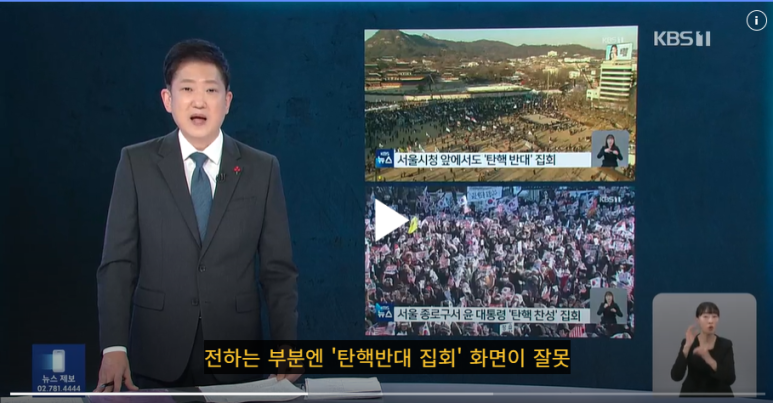
Yesterday (11th), KBS aired footage during its 5 PM news segment covering the ‘Seoul downtown rallies for and against impeachment.’The footage mistakenly showed scenes from the pro-impeachment rally during coverage of the anti-impeachment rally, and vice versa.
We hereby correct this error. KBS has established a broadcast accident investigation committee to thoroughly examine the details behind this mistake and take strict measures against those responsible. Additionally, we will implement measures to prevent such incidents from happening in the future. We sincerely apologize to our viewers.
The Future of South Korean Democracy
Among younger South Koreans, the sentiment that “KakaoTalk censorship is scarier than martial law” has gained traction. The DPK’s dominance in the National Assembly has enabled it to exert significant influence over the executive and judicial branches, leading to accusations of ideological purges and public witch hunts against dissenting citizens and public figures.
These actions pose a severe threat to freedom of expression and individual rights, challenging the very foundation of South Korea’s democracy.
The Democratic Party’s Hardline Strategy
The DPK has long been accused of pursuing pro-China and anti-U.S. policies. While advocating for the surveillance of citizens’ private communications on platforms like KakaoTalk, the party has opposed legislation aimed at punishing Chinese spies under espionage laws. Additionally, the DPK has intensified controversy by labeling President Yoon’s measures against North Korea’s acts of aggression as “acts of foreign rebellion.”
On January 9, the DPK reintroduced a controversial special investigation bill targeting government actions such as the use of loudspeakers along the North Korean border, the dissemination of anti-North Korean leaflets, and military deployments to conflict zones abroad, categorizing these as “acts of foreign rebellion.” The DPK claims that these measures aim to investigate suspicions that President Yoon intended to provoke war. However, the ruling People Power Party has countered, stating that the bill targets the Yoon administration’s overall security policy and is an unprecedented overreach.
The special investigation bill has shifted the debate from constitutional questions to national security concerns.
Amid declining approval ratings, the DPK has doubled down on its hardline approach. Despite controversies surrounding KakaoTalk surveillance, the party has strengthened its crackdown on so-called “fake news” and is reportedly considering impeachment motions against Acting President Choi Sang-mok and Public Officials Crime Investigation Unit Chief Oh Dong-woon if efforts to arrest President Yoon fail.
The Voice of America (VOA), a U.S. government broadcaster, recently addressed the issue on its flagship program “Washington Talk,” stating, “If the CIO (Corruption Investigation Office) attempts to arrest President Yoon, it would clearly overstep constitutional boundaries.” The ruling party responded by asserting that “this demonstrates that intervention is warranted when lines are crossed.”
These developments represent a pivotal moment for South Korea’s democracy. The international community must closely observe how the nation navigates this crisis and upholds its foundational principles of rule of law and democratic governance.
#SouthKoreaDemocracy
#FreedomOfExpression
#RuleOfLaw
#DemocracyUnderSiege
#PoliticalCrisis
#CensorshipInKorea
#HumanRights
#LegacyMedia
#Polarization
#FreeSpeechKorea
#DemocraticValues
#ConstitutionalRights
#MediaBias
#SouthKoreaPolitics
 Dr. KyuJin Shim's blog
Leave a comment